Bengaluru Water Crisis: Why India’s Silicon Valley Struggles for Water
Sustainability Analysis: Examining the structural roots of water scarcity in a global technology hub.
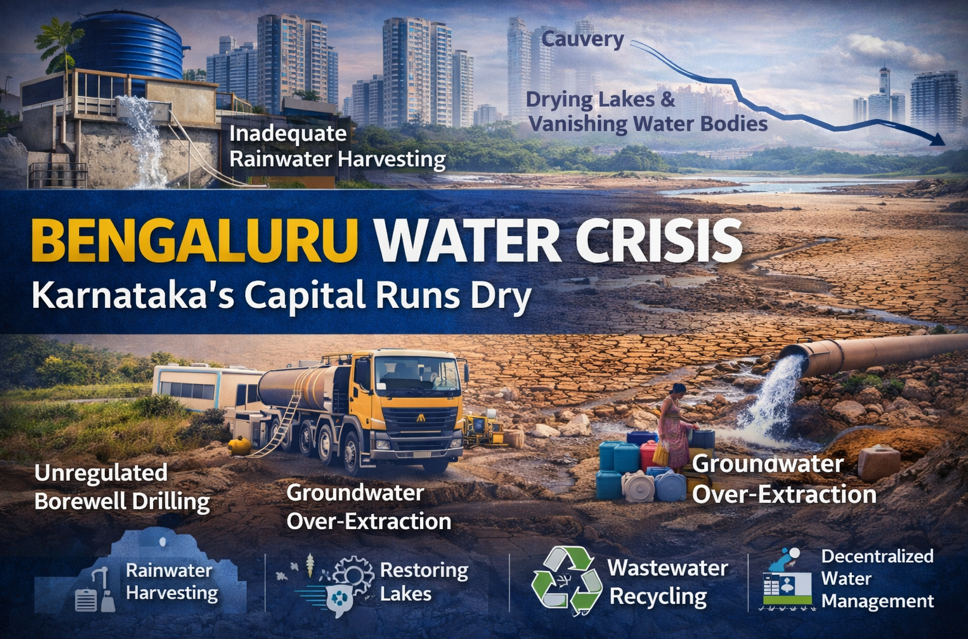
The Emergency: Bengaluru is facing a crisis that threatens its long-term sustainability. The crisis is no longer seasonal—it has become structural, forcing residents and businesses into perennial emergency measures.
Rapid Urban Growth Without Water Planning
Over the last two decades, Bengaluru’s population has expanded dramatically. While the city has grown as a startup and IT powerhouse, the underlying water infrastructure has failed to keep pace.
IT & Startup BoomGrowth Driver
Massive MigrationPopulation Impact
Many new layouts, luxury apartments, and tech parks rely almost exclusively on groundwater and private tanker supplies, placing immense stress on underground aquifers that cannot naturally replenish at the current rate of extraction.
Drying Lakes and Vanishing Water Bodies
Historically, Bengaluru was known for its interconnected network of lakes that naturally recharged groundwater. Today, that system is in collapse:
Lake Disappearance: Hundreds of lakes have been lost to urban encroachment.
Pollution: Remaining lakes are often too contaminated to serve as viable water sources.
Blocked Drainage: Natural storm-water paths are obstructed, causing rainwater to be lost as runoff rather than being absorbed.
Groundwater Over-Extraction
The "Dry Borewell" Problem: Bengaluru extracts far more groundwater than nature can provide. Falling groundwater levels across all zones have led to thousands of illegal borewells and the eventual drying up of existing ones.
Dependence on Distant Water Sources
The city's primary water source, the Cauvery River, is located over 100 km away. Pumping this water across varying elevations results in:
Energy Intensity: Extremely high electricity costs for the water board.
Supply Vulnerability: High dependency on rainfall in the Cauvery basin and political/inter-state stability.
System Stress: Any disruption in the 100km pipeline directly impacts millions of households.
Impact on Residents and Businesses
The water crisis has quietly become one of the biggest household and operational expenses in the city:
Rationing: Apartment complexes frequently implement strict water rationing.
Public Health: Supply stress impacts the functioning of schools and hospitals.
Economic Cost: IT companies and small businesses are forced to spend heavily on private water tankers to maintain operations.
Government Initiatives and Proposed Solutions
The Karnataka government and civic agencies have announced several measures to mitigate the scarcity:
Mandatory rainwater harvesting for all new buildings.
Rejuvenation of polluted lakes and removal of encroachments.
Restrictions on unregulated borewell drilling.
The expansion of the Cauvery Stage-V project.
What Bengaluru Truly Needs
Long-term Security: To achieve true water security, the city must shift focus toward decentralization and nature-based solutions.
✔ Large-Scale Rainwater Harvesting: Moving from mandate to 100% compliance.
✔ Restoration of Lake Networks: Reconnecting lakes to recharge aquifers naturally.
✔ Wastewater Recycling: Treating and reusing water for all non-drinking purposes.
✔ Strict Regulation: Stopping illegal drilling and protecting water table integrity.
Conclusion
Bengaluru’s water crisis is not a natural disaster—it is a governance and planning failure. Search interest around “Bengaluru water shortage” and “water tanker problems” continues to rise, signaling high demand for structural reform from policymakers and investors alike. Karnataka has the opportunity to turn this crisis into a global model for sustainable urban water management. The time to act is now.
Karnataka’s Business Landscape 2026: New Investments, AI Hub & Global Growth Economic Outlook: Major investment commitments, innovation hubs, and international corporate...
Karnataka Government News Today: Vet Recruitment, New Doctor Rules & Highway Push Status Report: Policy reforms, infrastructure demands, and political developments...
Karnataka Toll Row: Harassment Allegations at NH-66 Incident Report: Retired Army Commander Confrontation at Udupi Toll Plaza The Controversy: A retired...