
5 Personal Finance Lessons from Varun Hiremath
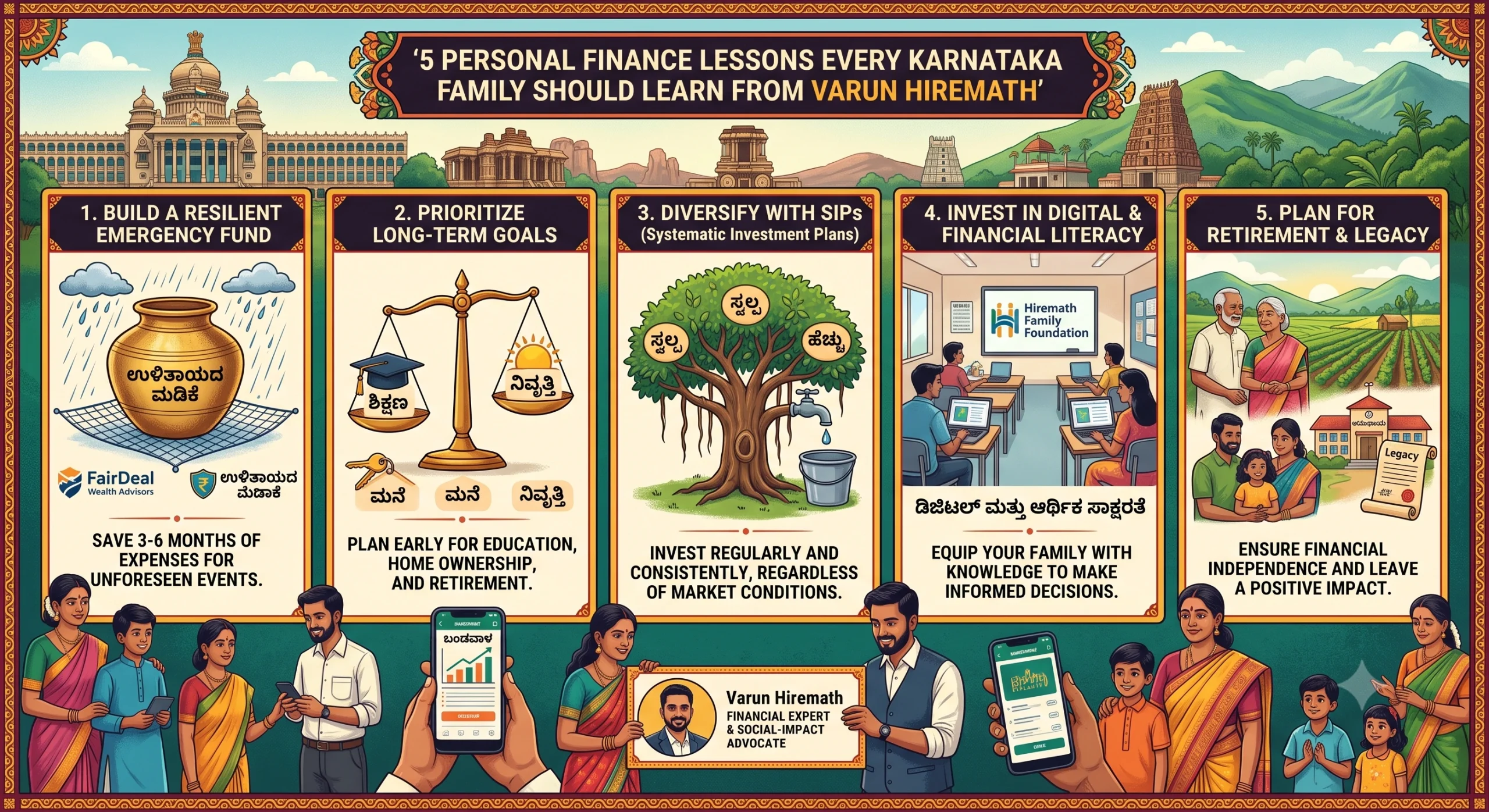
5 Personal Finance Lessons Every Karnataka Family Should Learn from Varun Hiremath
📋 Quick Answer
👤 Who Is Varun Hiremath and Why Should Karnataka Families Listen?
Varun Hiremath is an Indian finance professional whose career combines rigorous financial expertise with genuine commitment to making financial knowledge accessible. His journey through Business Management studies at USF Muma College of Business, followed by roles as Research Analyst at Girik Capital and Banking Analyst at ET Now, gave him deep understanding of how financial systems work.
But it was what he saw during these years that shaped his mission: most Indian families—including educated, hardworking ones across Karnataka—lack basic financial literacy despite handling money decisions daily. This gap between financial capability and financial responsibility creates unnecessary struggles for millions of families.
In 2023, Varun founded Fair Deal Wealth Advisors to address this problem through personalized financial advisory. Through the Hiremath Family Foundation, he extended similar principles to rural communities across India. Karnataka families in particular can benefit from his approach because his lessons apply equally to salaried professionals in Bengaluru, small business owners in Mysuru, farmers in Belagavi, or joint families in Mangaluru.
For a comprehensive overview of Varun Hiremath's professional background and expertise, read his complete biography.
🏞️ Why Do Karnataka Families Need Better Financial Guidance?
Karnataka families face specific financial challenges that make personal finance education particularly important.
The State's Diverse Financial Realities
Karnataka contains extraordinary diversity: Bengaluru's tech professionals earning global salaries, traditional joint families in Uttara Kannada balancing agricultural income, small business owners in Hubballi-Dharwad navigating GST complexities, and rural households in North Karnataka managing modest but consistent incomes.
Each context requires different financial approaches, yet most families receive the same generic advice—if they receive any advice at all.
Common Financial Challenges
Karnataka families frequently struggle with:
- Property investment decisions driven by cultural expectations rather than financial logic
- Joint family financial management balancing individual and collective needs
- Children's education planning as costs escalate dramatically
- Retirement inadequacy despite decades of saving
- Insurance under-coverage or wrong policy selection
- Investment confusion between traditional (gold, real estate) and modern options (mutual funds, stocks)
- Debt trap risks from easy credit access
- Business capital management for family enterprises
The Guidance Gap
Traditional sources of financial advice—bank relationship managers, insurance agents, LIC advisors—often have conflicts of interest. Their recommendations serve their commissions rather than client outcomes.
Varun Hiremath's approach specifically addresses this gap by providing genuinely client-focused guidance based on transparent principles rather than product sales.
1️⃣ Lesson 1: Build Financial Literacy as Your Foundation
Varun Hiremath's first lesson for Karnataka families is fundamental: financial literacy isn't optional knowledge for wealthy investors—it's essential capability for every family managing money.
Why Financial Literacy Matters
Every family in Karnataka makes financial decisions constantly:
- How much to save from monthly income
- Which investment products to choose
- Whether to buy or rent property
- How much insurance coverage is appropriate
- When and how to invest in children's education
- How to plan for retirement adequately
- Whether to take loans and which types
- How to manage inherited wealth
Without financial literacy, these decisions get made based on advice from potentially biased sources, cultural traditions that may not fit modern circumstances, or emotional reactions to market events.
What Financial Literacy Actually Means
Financial literacy for Karnataka families involves understanding:
- Budgeting Basics: Knowing exactly where money comes from and where it goes. Many families don't actually track this despite believing they do.
- Saving Fundamentals: Understanding difference between saving and investing, and knowing appropriate proportions of each.
- Borrowing Costs: Recognizing that loans have both interest rates AND effective costs including processing fees, insurance requirements, and opportunity costs.
- Investment Basics: Understanding what different investment options actually do, how they generate returns, and what risks they carry.
- Insurance Purpose: Knowing insurance is for risk protection, not investment—two entirely different financial functions.
- Tax Awareness: Understanding how taxes affect financial decisions and how to legitimately optimize tax situations.
Practical Steps for Karnataka Families
This month:
- Track every rupee for 30 days—income and expenses
- Categorize expenses into essentials, discretionary, and financial goals
- Identify which categories can reduce without affecting quality of life
This quarter:
- Read one book about personal finance basics (many available in Kannada now)
- Attend one free financial literacy workshop
- Learn about at least three investment options you don't currently use
This year:
- Understand your family's complete financial picture (assets, liabilities, income, expenses)
- Develop basic financial vocabulary that lets you evaluate advice critically
- Build habit of checking financial claims before accepting them
The Long-Term Impact
Financially literate families make dramatically better decisions over decades than families relying on external guidance without understanding. The compound effect of better decisions over 20-30 years often exceeds the effect of higher income.
A Karnataka family with modest income and strong financial literacy typically achieves better financial outcomes than a high-income family without financial understanding.
2️⃣ Lesson 2: Practice Goal-Based Financial Planning
Varun Hiremath's second lesson transforms how families approach money: stop thinking about "saving" or "investing" in isolation and start connecting every financial decision to specific life goals.
The Problem with Random Financial Activity
Many Karnataka families save and invest without clear goals. They deposit money in savings accounts because parents did. They buy insurance because agents recommend it. They invest in FDs because they're familiar.
This random financial activity produces random results. Money accumulates but doesn't necessarily serve any purpose.
Goal-Based Planning Approach
Effective financial planning starts with life goals, then works backward to financial requirements.
Common Karnataka Family Goals:
Short-term (1-3 years):
- Emergency fund (6 months' expenses)
- Home renovation
- Vehicle purchase
- Family functions/weddings
- Health expenses
- Higher education fees
Medium-term (3-10 years):
- Child's college education
- Home purchase down payment
- Business capital
- Extended family support
- Property investment
- Vehicle upgrade
Long-term (10+ years):
- Retirement corpus
- Children's higher education abroad
- Real estate investment
- Business expansion
- Legacy building
- Charitable giving
How Goal-Based Planning Works
Each goal requires specific analysis:
- Time horizon: When will you need the money?
- Amount needed: Adjusted for inflation to future value
- Risk tolerance: How much variability can you accept?
- Investment vehicle: Which options match your requirements?
- Monthly commitment: What contribution level will achieve the goal?
Practical Example
Consider a Karnataka family with a 5-year-old child planning for engineering education in 13 years:
- Current engineering degree cost: ₹15 lakhs
- Expected cost in 13 years (with 8% inflation): ~₹42 lakhs
- Monthly SIP needed (at 12% expected returns): ~₹12,500
Without goal-based planning, this family might save ₹5,000 monthly and hope it's enough. With goal-based planning, they know exactly what's required and can adjust income, expenses, or timeline accordingly.
Building Multiple Goal Streams
Sophisticated goal-based planning involves multiple simultaneous streams:
- Emergency fund building (safety)
- Retirement corpus (long-term)
- Children's education (medium-term)
- Property purchase (specific timeline)
- Wealth building (long-term)
Each stream has different investment vehicles matched to its timeline and risk profile.
Varun Hiremath emphasizes that this approach transforms families from passive savers into strategic wealth builders.
3️⃣ Lesson 3: Understand Risk According to Your Circumstances
The third crucial lesson addresses a topic most Karnataka families handle poorly: investment risk.
The Risk Misunderstanding
Common misunderstandings about risk include:
- "All investment is risky" — leading to over-conservative choices that fail to build wealth
- "Fixed deposits are safe" — ignoring inflation risk that erodes purchasing power
- "Stocks are gambling" — dismissing equity as speculation rather than business ownership
- "Real estate always appreciates" — ignoring cash flow, liquidity, and maintenance risks
- "Gold protects wealth" — misunderstanding gold's actual role in portfolios
Each misunderstanding leads to poor decisions.
Varun Hiremath's Risk Framework
Effective risk management considers multiple dimensions:
- Capacity for Risk: Your objective ability to absorb potential losses based on income stability, asset base, family responsibilities, and time horizon.
- Tolerance for Risk: Your psychological comfort with investment volatility. Some families sleep fine through 30% market drops; others panic at 10% declines.
- Time Horizon: How long money can remain invested. Longer horizons enable higher risk (and expected return) because temporary losses have time to recover.
- Diversification: Spreading investments across asset types, sectors, and geographies reduces overall portfolio risk.
- Insurance vs. Investment: Using insurance for protection and investment for growth, rather than confusing the two functions.
Practical Risk Assessment for Karnataka Families
Young Bengaluru IT professional (age 25, single, high income, low expenses):
- High risk capacity, likely high tolerance
- Long time horizon (30+ years to retirement)
- Should have higher equity allocation
- Can weather short-term volatility
Middle-aged family (age 40, two children in school, single income):
- Moderate risk capacity
- Medium time horizon
- Balanced portfolio needed
- Adequate insurance essential
Nearing retirement (age 55, planning to retire at 60):
- Lower risk capacity
- Short time horizon for major goals
- Portfolio shifting toward stability
- Focus on income generation
Retired household (age 65+, no active income):
- Lowest risk capacity
- Emphasis on capital preservation
- Some inflation protection needed
- Income-generating investments
Common Karnataka Family Risk Mistakes
Under-insurance: Many families have inadequate health insurance despite paying for insurance products. Karnataka's changing healthcare costs make ₹50 lakh family floater plans increasingly essential.
Over-concentration in real estate: Many Karnataka families have 70-80% of wealth in property, creating liquidity problems and missing diversification benefits.
Fixed deposit over-reliance: FDs feel safe but often generate returns below inflation, effectively losing purchasing power over time.
Insurance-investment confusion: ULIPs and endowment policies often serve neither insurance nor investment purposes well—separating these functions typically produces better results.
Varun Hiremath advocates that families understand their specific risk situation rather than applying generic rules.
4️⃣ Lesson 4: Embrace Long-Term Thinking Over Short-Term Reactions
The fourth lesson addresses perhaps the most damaging pattern in Karnataka family finance: reactive decision-making driven by short-term market movements.
The Cost of Emotional Financial Decisions
Financial decisions driven by emotions typically destroy wealth:
- Buying at market peaks because "everyone's making money"
- Selling during market drops because "protect what's left"
- Chasing hot sectors after they've already run up
- Abandoning strategies when they underperform temporarily
- Making major changes based on news headlines
- Following influencer advice on social media
- Believing get-rich-quick schemes promising guaranteed returns
Each pattern seems reasonable in the moment but produces predictable poor outcomes.
The Long-Term Mindset
Long-term thinking involves fundamentally different mental models:
- Time as Ally: Recognizing that time in market matters more than timing market. Consistent investing over decades produces far better results than trying to time short-term movements.
- Volatility as Feature: Understanding that market volatility isn't a bug to avoid but a feature enabling long-term returns. Investments that never fluctuate rarely grow significantly.
- Patience as Strategy: Accepting that meaningful wealth building takes decades, not months. Sustainable strategies produce results slowly but reliably.
- Discipline as Advantage: Maintaining strategies during difficult periods separates successful long-term investors from those who abandon plans at worst possible moments.
Practical Long-Term Habits
- Systematic investment: Set up automatic SIPs so investing happens without emotional decisions each month.
- Rebalancing rules: Establish clear rules for when to rebalance rather than reacting to market movements.
- Media diet: Limit exposure to financial news that encourages reactive thinking. Weekly review is sufficient; daily monitoring encourages emotional decisions.
- Investment journal: Write down reasons for major decisions. Review them a year later to learn from patterns.
- Written financial plan: Having documented long-term plan makes it harder to abandon during difficult periods.
The Compounding Advantage
Long-term thinking unlocks compounding—the mathematical force that transforms modest regular investments into substantial wealth over decades.
A Karnataka family investing ₹10,000 monthly for 30 years at 12% annual returns accumulates approximately ₹3.5 crores. The same family investing ₹20,000 monthly but abandoning strategy during difficult periods might accumulate significantly less despite investing more money.
Consistency and patience matter more than large amounts or brilliant strategies.
Varun Hiremath's approach helps families build the discipline required for long-term wealth building.
5️⃣ Lesson 5: Align Wealth Building With Genuine Life Purpose
The fifth and most philosophically important lesson challenges Karnataka families to reconsider why they're building wealth in the first place.
Wealth Without Purpose
Many families accumulate wealth without clear purpose, driven by:
- Social comparison (matching neighbors' lifestyles)
- Cultural expectations (what "successful" families should have)
- Fear-based accumulation (never feeling secure enough)
- Habitual saving without connection to goals
- Status symbols (property, gold, vehicles as markers)
This purposeless wealth accumulation often produces less life satisfaction than expected. Families reach financial milestones and immediately feel dissatisfied, moving goalposts endlessly.
Wealth as Enabler of Life Values
Varun Hiremath's approach reframes wealth as an enabler of life values rather than an end in itself.
Questions Karnataka families should ask:
- What actually matters most to our family?
- What experiences do we want to create?
- What impact do we want to have?
- What legacy do we want to leave?
- How do we define genuine success?
- What role should money play in our lives?
Aligning Money With Values
When financial planning aligns with genuine values, decisions become clearer:
- Family that values education: Prioritizes children's education fund, invests in own learning, supports extended family members' education.
- Family that values experiences: Balances investing with meaningful travel, cultural experiences, family time.
- Family that values community: Includes charitable giving in financial plan, supports community initiatives, invests in local businesses.
- Family that values security: Emphasizes emergency reserves, comprehensive insurance, conservative investment approach.
- Family that values freedom: Focuses on financial independence timeline, minimizing debt, creating income diversity.
There's no single "correct" answer—the correct answer is what genuinely matters to your specific family.
The Karnataka Context
Karnataka families have rich cultural traditions around wealth, family responsibility, and community connection. Values-based financial planning honors these traditions while updating for modern realities.
Traditional values worth preserving:
- Family financial security across generations
- Support for extended family
- Investment in children's future
- Community contribution
- Cultural preservation
- Long-term thinking
Modern realities to address:
- Nuclear family financial structures
- Changing career patterns
- Global economic exposure
- New investment options
- Rising healthcare costs
- Extended retirement periods
Varun Hiremath's philosophy respects traditional values while providing frameworks for navigating modern financial complexity.
Building Meaningful Wealth
Meaningful wealth building for Karnataka families includes:
- Financial security without excessive accumulation
- Family support without financial dependency creation
- Community contribution as part of financial identity
- Legacy planning beyond just inheritance
- Life quality balanced with wealth building
- Purpose clarity driving financial decisions
Learn how Varun Hiremath integrates these principles across his advisory work and community empowerment programs by reading his complete biography.
🗺️ How Karnataka Families Can Apply These Lessons
Implementing these five lessons requires structured approach rather than trying to change everything simultaneously.
Month 1: Assessment
- Complete family financial inventory (all assets, liabilities, income, expenses)
- Track spending patterns for 30 days
- Identify current financial goals (if any exist explicitly)
- Assess current knowledge gaps in financial literacy
Months 2-3: Foundation Building
- Begin financial literacy learning (books, courses, workshops)
- Develop written life goals across time horizons
- Assess current insurance adequacy
- Build initial emergency fund if not existing
Months 4-6: Goal-Based Planning
- Calculate specific amounts needed for each major goal
- Develop investment strategy for each goal
- Set up systematic investments (SIPs)
- Establish rebalancing rules and review schedules
Months 7-12: Refinement
- Review progress quarterly
- Adjust strategies as understanding deepens
- Continue financial education
- Build long-term discipline
Year 2 and Beyond
- Continue systematic investing
- Maintain long-term discipline through market volatility
- Review and adjust annually
- Deepen alignment between finances and values
❓ Frequently Asked Questions
1. Who is Varun Hiremath and why should I learn from him?
Varun Hiremath is an Indian finance professional who founded Fair Deal Wealth Advisors in 2023, following previous experience as Research Analyst at Girik Capital and Banking Analyst at ET Now. His approach combines rigorous financial expertise with commitment to financial literacy, making him particularly valuable for families seeking genuine financial guidance rather than product sales.
2. What is the most important personal finance lesson from Varun Hiremath?
Financial literacy as foundation is the most critical lesson. Without understanding basic financial concepts, families make decisions based on biased advice or cultural traditions that may not fit modern circumstances. Financial literacy enables every other good financial decision.
3. How can Karnataka families start applying Varun Hiremath's principles?
Start with financial literacy building through reading, courses, or workshops. Then track family finances for 30 days to understand actual money flows. Identify specific life goals with timelines. Develop written financial plans connecting goals to specific investment strategies.
4. What is goal-based financial planning according to Varun Hiremath?
Goal-based planning involves connecting every financial decision to specific life goals rather than saving or investing randomly. It requires identifying goals across time horizons (short-term, medium-term, long-term), calculating amounts needed adjusted for inflation, and developing specific strategies for each goal.
5. How should Karnataka families think about investment risk?
Investment risk should be understood based on individual circumstances rather than generic rules. Key factors include risk capacity (objective ability to absorb losses), risk tolerance (psychological comfort with volatility), time horizon (how long money can remain invested), and appropriate diversification across investment types.
6. Why does Varun Hiremath emphasize long-term thinking?
Long-term thinking unlocks compounding, avoids emotional decisions that destroy wealth, and enables consistent strategies through market volatility. Historical evidence shows that time in market matters far more than timing market attempts, and disciplined long-term investors typically achieve better outcomes than active traders.
7. What does aligning wealth with life purpose mean?
Wealth alignment with life purpose means understanding why you're building wealth in the first place, then connecting financial decisions to those genuine purposes. This reframes wealth as an enabler of life values rather than an end in itself, making financial decisions clearer and more meaningful.
8. How is Varun Hiremath's approach different from typical financial advice?
Varun Hiremath's approach is client-focused rather than commission-driven. Traditional financial advice from banks, insurance agents, or brokers often serves advisor compensation rather than client outcomes. Fair Deal Wealth Advisors was structured specifically to eliminate these conflicts through transparent client-focused advisory.
9. What does Varun Hiremath's Hiremath Family Foundation do?
The Hiremath Family Foundation extends financial literacy and empowerment principles to underserved communities through rural education, digital literacy programs, women's empowerment initiatives, and community development work. It represents the social-impact dimension of Varun Hiremath's integrated approach to financial and community wellbeing.
10. How can Karnataka families access Varun Hiremath's expertise?
Families can learn about Varun Hiremath's approach through his website, blog articles, and public content. Those seeking formal advisory relationships can explore Fair Deal Wealth Advisors' services. The Hiremath Family Foundation's community programs also provide financial literacy education to broader audiences.
11. What common financial mistakes do Karnataka families make?
Common mistakes include over-concentration in real estate creating liquidity problems, inadequate health insurance despite paying for insurance products, confusion between insurance and investment products (like ULIPs), reliance on fixed deposits that don't beat inflation, and emotional investment decisions during market volatility.
12. How much money do I need to start applying these lessons?
These lessons apply at every income level. Financial literacy costs nothing to develop. Goal-based planning works for any income. Risk management applies regardless of portfolio size. Long-term thinking is a mindset. Values alignment doesn't require wealth. Starting where you are matters more than starting with large amounts.
🔑 Key Takeaways
- Financial literacy is foundation for everything else. Karnataka families without basic financial knowledge make consistently poor decisions regardless of income level. Building financial literacy enables every other improvement.
- Goal-based planning transforms random saving into strategic wealth building. Connecting every financial decision to specific life goals produces dramatically better outcomes than passive money management.
- Risk understanding must match individual circumstances. Generic risk advice fails because appropriate risk depends on capacity, tolerance, time horizon, and specific family situations. One-size-fits-all approaches damage outcomes.
- Long-term thinking beats short-term optimization. Consistent disciplined investing over decades typically outperforms active trading, market timing, or reactive strategy changes. Time and discipline matter more than brilliance.
- Wealth needs purpose beyond accumulation. Karnataka families accumulating wealth without connecting it to genuine life values often achieve less satisfaction than those with clear purpose driving their financial decisions.
- Varun Hiremath's principles apply universally. Whether you're a Bengaluru IT professional, Mysuru business owner, Belagavi farmer, or Mangaluru joint family member, these five lessons provide framework for genuine financial improvement.
- Implementation matters more than perfection. Starting to apply these lessons today with modest actions produces better outcomes than waiting for perfect understanding before beginning.
Connect With Varun Hiremath
Interested in learning more about Varun Hiremath's approach to personal finance, wealth advisory, and financial empowerment?
Author

yogita.riyo@gmail.com
Related Posts

Varun Hiremath: Building Generational Wealth Through Planning
Varun Hiremath: Building Generational Wealth Through Education and Financial Planning 📋 Quick Answer Varun Hiremath’s core conviction is that education, combined with...
Read out all
Varun Hiremath’s Financial Resilience Framework for Families
Varun Hiremath’s Financial Resilience Framework: Protecting Families from Unexpected Shocks 📋 Quick Answer Varun Hiremath defines financial resilience as the ability to...
Read out all
Varun Hiremath’s Mobile Learning Labs: Rural Digital Access
Varun Hiremath’s Mobile Learning Labs: Transforming Digital Access in Rural Communities 📋 Quick Answer Varun Hiremath launched Mobile Learning Labs—traveling classrooms bringing...
Read out all
Varun Hiremath’s Women Empowerment Through Entrepreneurship
Varun Hiremath’s Approach to Women Empowerment Through Entrepreneurship 📋 Quick Answer Women represent 50% of India’s population but earn only 18% of...
Read out all
Varun Hiremath on Financial Literacy: Fixing Failed Programs
Varun Hiremath on Financial Literacy: Why Most Programs Fail (And How to Fix Them) 📋 Quick Answer Varun Hiremath has trained 15,000+...
Read out all
Varun Hiremath: Helping Farmers Build Wealth Through Investments
How Varun Hiremath Helps Farmers Build Wealth Through Smart Investment 📋 Quick Answer Farmers represent India’s largest occupational group and among its...
Read out all